Ivy's black bicycle
When our grandmother Ivy began making the Cheddar that still carries her name, cheesemaking was a very different sort of business, altogether smaller and more local. The farm that Ivy helped run with her husband Tom was well-established, but her cheesemaking enterprise began as a sideline, and for a while she sold most of what she produced locally.
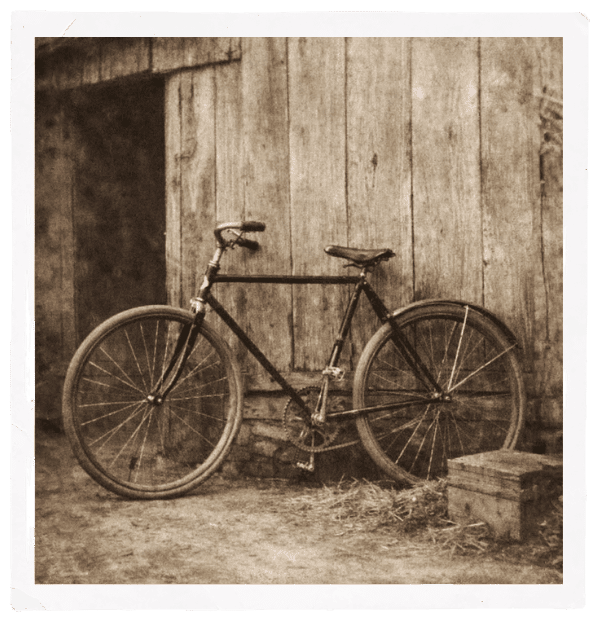
Since she only learned to drive a car in her fifties, she would often transport her Cheddar on the back of her bicycle, bringing back other produce to the farm on her return. A large-framed black “bone-shaker”, this bicycle was a familiar sight around the village of Wyke Champflower and beyond, and she continued to use it long after the fame of her Cheddar meant other arrangements needed to be made for transportation.
A century ago, life for everyone in England was much more contained, but especially so in the countryside. Ivy’s life was tied deeply first to her family, with four children to raise, then to the people working in the dairy and on the farm, and after that to her community. As well as being involved in the activities and events that revolved around the church, Ivy and Tom would have parties and dances, would attend village and district celebrations of festivals and holidays such as Christmas, Easter, Harvest and May Day, and so on. Like most people at the time, they wouldn’t have travelled far from home and took very rare holidays. For Ivy and her family, this stayed true even when her Cheddar began to win awards and receive attention around the country.
These days, Ivy’s Reserve is enjoyed all over the world, from China to the United States, in Europe, Australia and beyond. Ivy would be amazed and proud, we think, to know that the same carefully crafted Cheddar she had on the back of her bike is travelling quite so far from the rolling hills of Somerset.
Of course, it takes more than a bicycle to get to China, and however hard we try, the service isn’t as personal as receiving our Cheddar from the maker herself. But we think Ivy would also appreciate that the world has come back round to her choice of transport, with the bicycle championed as the vehicle of the future as well as of the past.
After the war, cheese production changed fast from the artisan techniques Ivy employed to mass-production, and Cheddar was one of the cheeses that were most affected by this. Quantity was considered more important, and Ivy’s principles of craft, care and taking the time to do things properly – principles we’ve always proudly upheld – were not as highly valued by others. We’re happy that, as with the bicycle, the wheel has turned full circle here.
As well as handing down her recipes for cheese and butter, Ivy taught us to work closely with nature and tread lightly on the land. Our work in sustainable farming, which means we now use 100% renewable energy from our own biogas plant, is directly inspired by her example. If we can’t deliver our Cheddar on a bicycle, it’s good to know that we can (and do) power one of our milk tankers (the first of many!) on self-generated electricity.
Ivy’s bicycle also served another purpose: a way to let off steam. Daughter Margaret remembers, “If she got really cross she’d take her bike and go and visit someone.” Our grandmother was a strong woman who worked incredibly hard, with a busy family and a business to run, so it’s not surprising she needed to get out and find her own space every now and then. We all know how she felt.