The language of cheese
If you’ve looked at the words on Ivy’s Reserve packs, you’ve probably noticed how we describe it: “Exceptionally smooth, strong & full-flavoured” for our Vintage Cheddar and “Rich & creamy, tangy, nutty, mellow & moreish” for Somerset Red. And while some of those are clear and straightforward – we all know what “moreish” means – others are heading into the technical area, as befits cheeses made with this much care and attention.
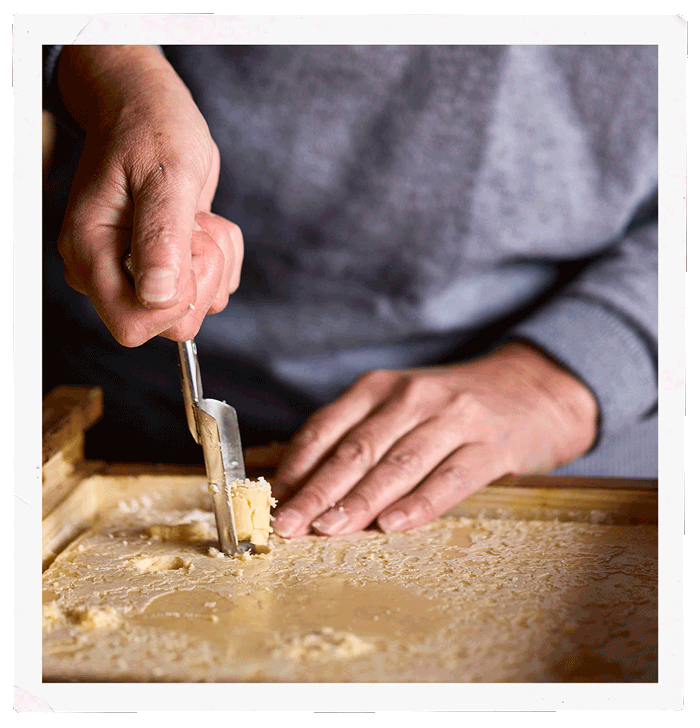
This is where the experts take over from us mere fans, and our chief expert is Diane Cox, our Master Grader. She’s in charge of ensuring that only the very best cheese goes out under the Ivy’s Reserve name, and for that she and her team need some special words. “It’s to ensure we all know the flavours and textures we require for each profile of cheese,” she explains. “When grading the cheese, we need to ensure we’re focused on the key attributes we require for each one.”
As in the world of wine, many of these terms are buried in the mists of time, passed down from grader to grader and then adapted. “There are lots of generic terms used to describe the flavours in all cheeses, but what’s an attribute in some cheese can be a defect in another cheese type,” says Di. “The best terms we use are the ones we have adopted to describe our cheeses. Some of these probably wouldn’t translate well to other cheesemakers and a lot of the time we just refer to the flavours as being ‘Ivy’s’, as we’ve all done it for long enough to know what we mean!”
When it comes to our Vintage Cheddar, Di gives us a list of the kinds of words she and her team might be using: “Flinty, cliff-edged texture, crunchy, complex, intense, strong, tangy, earthy, robust, bold, toasty, lingering, savoury, sweet, nutty, caramel, toasted, rich.” She points out that “A lot of the terms used for Vintage feel a bit too masculine for my liking!”, and that a great cheese is all about bringing these sometimes conflicting factors together: “It’s the balance of all the flavours that makes the cheese so good. With the Ivy’s Reserve Vintage, as it ages the intensity of the flavours increases and the texture becomes more flinty, and obviously the classic crunch develops.”
Digging into some of those terms really shows the outstanding characteristics of the Vintage. “Flinty” is a word used for hard, aged cheeses and covers both the texture and also a clean, mineral or “stony” flavour. “Earthy”, which often comes into play with long-aged cheeses, is also talking about these flavours, which develop with maturation. “Toasty” suggests the warmer, sweeter flavours and works with “caramel” – that taste of toasted bread or browned butter. “Nutty” is another factor of this, giving hints of savoury with sweet, just like roasted nuts.
For Somerset Red, Di’s list is “Flinty, crunchy texture, open-textured, rich, indulgent, opulent, sweet, caramel, nutty, butterscotch, tangy, crisp, savoury”. Some of the same terms crop up from the Vintage – not so surprising since, as she points out, “it shows they’re part of the same family” – but also some new ones. Some of these, such as “indulgent” and “opulent”, come from that delicious creaminess, but there are contrasting notes from “bright” and “tangy”. These both talk about acidity, with the first giving us a clean flavour and the second the idea of mouth-watering. The unexpected “crisp” is in the same area, too, with a sense of the refreshment of the acidity, as in a white wine or an apple. And that “open-textured” is talking about the crumbliness of a premium cheese, the irregular structure that comes from longer ageing.
And what about the words that Di doesn’t want to hear? “Well, the terms we don’t like are acid, lactic, grassy, farmy, fruity, harsh and sharp,” she says. Most of these suggest that the balance has gone too far in a particular direction, usually towards the acid and away from the sweetness. For another cheese, she points out, “farmy” and “fruity”, which suggest fermentation smells, might even be what’s wanted for a different cheese. For Ivy’s Reserve, though, they don’t make the grade.